
In Bangkok, the Skytrain (BTS), the underground (MRT) and the Airport Rail Link let you avoid traffic on most central journeys. When choosing a home, what matters most is the actual walking distance to the station and the number of changes to your office or school. Taxis, ride-hailing apps, motorbike taxis and boats complete the network.
Bangkok has a reputation for traffic jams, and it often lives up to it at rush hour. Yet much of daily life can be organised without a car, thanks to an urban rail network that has expanded greatly in recent years. For an expat, this is a decisive factor in choosing a home: an apartment a few minutes' walk from a station changes daily life completely. This guide presents the main lines, how people use them and our tips for choosing a home based on your journeys.
1.The lines to know
The BTS (Skytrain), an elevated railway, has two main lines:
- the Sukhumvit line (light green), which runs through the neighbourhoods most popular with expats: Nana, Asok, Phrom Phong, Thong Lo, Ekkamai, Phra Khanong, On Nut, then continues east and south-east, and north towards Ari, Mo Chit and beyond;
- the Silom line (dark green), serving the historic business district (Sala Daeng, Chong Nonsi) and crossing the river to Thonburi.
The two lines meet at Siam, in the heart of the shopping district.
The MRT, underground and elevated, includes:
- the Blue line, a loop linking Sukhumvit, Rama 9, Huai Khwang, Lat Phrao, Chatuchak, Hua Lamphong station, Chinatown and Thonburi;
- the Purple line, towards Nonthaburi in the north-west;
- the newer Yellow and Pink monorail lines, serving the east and north of the metropolitan area.
The Airport Rail Link (ARL) connects Suvarnabhumi airport with the city centre, as far as Phaya Thai, with connections to the BTS and MRT.
Several stations let you switch networks, for example Asok (BTS) and Sukhumvit (MRT), Sala Daeng (BTS) and Si Lom (MRT), Mo Chit (BTS) and Chatuchak Park (MRT), Makkasan (ARL) and Phetchaburi (MRT), Phaya Thai (BTS and ARL).
2.How to pay
For a long time each network had its own tickets. For the BTS, the rechargeable Rabbit card remains the most practical option for regular use. On the MRT and some other lines, you can now pay directly with a contactless bank card. Arrangements change: check on site or on the operators' websites which payment methods each line accepts.
Fares depend on distance, and passes exist for frequent journeys. Trains generally run from early morning until around midnight; exact hours vary by line.
3.Distance to the station: what it really changes
On our listings we show the nearest station and the distance. A few practical benchmarks:
- under 500 m: the station is truly "walkable", even in strong heat or monsoon rain;
- 500 m to 1 km: walkable, but many residents take a motorbike taxi for the last stretch, especially in the hot season;
- beyond that: you will rely on a building shuttle, a motorbike taxi or a ride-hailing car.
Also think about the walk itself: pavements, footbridges, covered walkways. Two homes at the same distance can offer very different walks.
4.Other ways to get around
- Taxis are plentiful and run on the meter; ask for it to be switched on.
- Ride-hailing apps (such as Grab or Bolt) show the price in advance, handy if you do not speak Thai.
- Motorbike taxis, recognisable by their coloured vests, wait at the entrance to sois (side streets): ideal for short trips to the station.
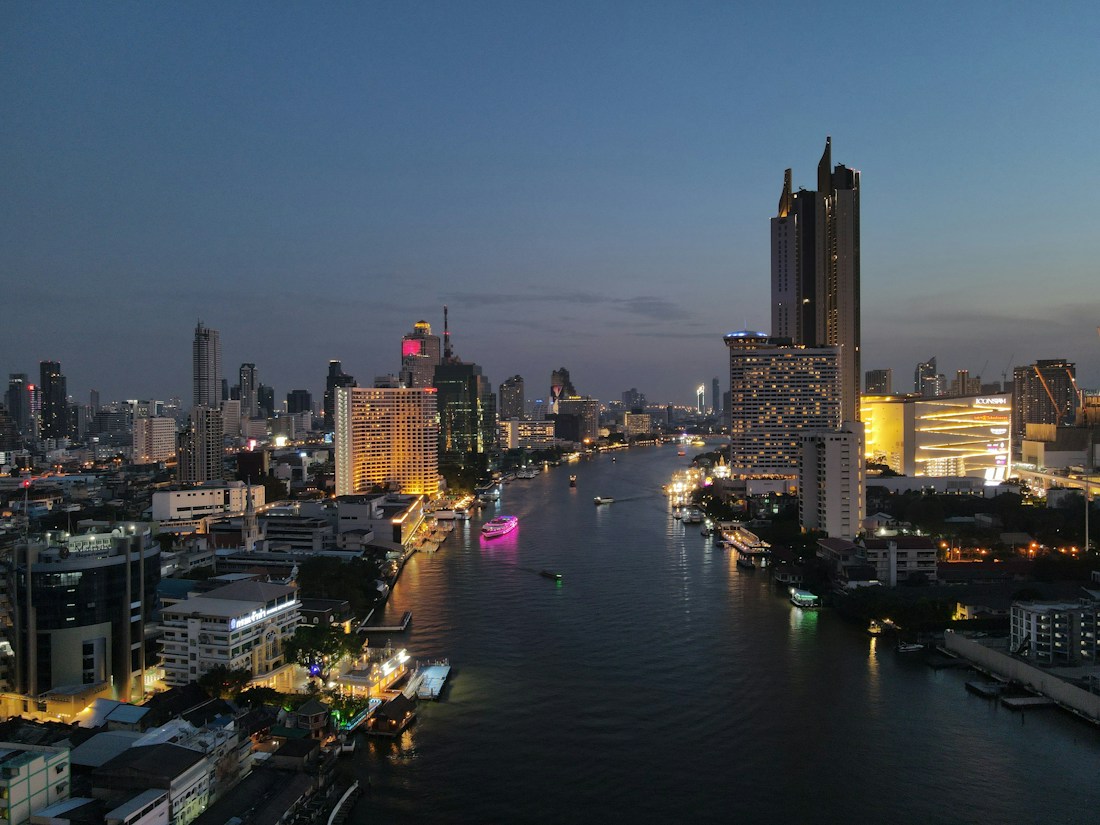
- Boats: the Chao Phraya Express serves the riverbanks, and the Saen Saeb canal boat quickly links some central districts.
- A car remains useful for families in the suburbs, but parking and rush-hour traffic limit its appeal in the centre.
5.Getting to the airports
- Suvarnabhumi, the main international airport, is linked to the centre by the Airport Rail Link. It is often the most predictable option at rush hour, especially with little luggage.
- Don Mueang, used by many low-cost airlines, can be reached by the suburban train (Red line) or by road.
With a lot of luggage or as a family, a taxi or ride-hailing car remains more comfortable, allowing extra time.
6.Choosing your home based on your journeys
These are the questions we always ask:
- Where are your office, your children's school and your regular activities?
- Which line serves them, and with how many changes?
- Are you happy to walk 10 minutes in strong heat, or do you prefer to be right by the station?
- Will you use a car?
Our guide Choosing your Bangkok neighbourhood for your lifestyle complements these benchmarks, and our neighbourhood guides detail the stations in each area.
7.Rush hour, heat and the rainy season
At rush hour, trains on the busiest lines (especially Sukhumvit) are very crowded: you may have to let one pass. Shifting your journey by a quarter of an hour is often enough to travel more comfortably. Heat and rain matter too: in the rainy season, a downpour can make a ten-minute walk unpleasant, and road traffic suffers badly. Covered walkways linking some stations to malls and office buildings are then invaluable: something to look at when viewing a home.
8.How we help
For every property we offer, we show the nearest station, the distance and an estimated walking time, and during a video viewing we can film the walk to the station. It is often this walk, more than the apartment itself, that makes the difference day to day.
Frequently asked questions
Can I pay for the metro with a bank card?
On the MRT and some lines, contactless bank card payment is possible. For the BTS, the Rabbit card remains the most practical. Check on site, as arrangements change.
What distance to the station is reasonable?
Under 500 m lets you walk everywhere. Between 500 m and 1 km, many residents use a motorbike taxi for the last stretch.
How do I get to Suvarnabhumi airport from the centre?
The Airport Rail Link connects Phaya Thai to the airport, with connections to the BTS and MRT. With a lot of luggage, a taxi or ride-hailing car is more comfortable.
Do I need a car to live in Bangkok?
Not if you live near a station and work in the centre. A car becomes useful for families in the suburbs or poorly served journeys.
General information updated on 10 October 2026; check your contract and with the Find Easy team.